


Actor portrayal
Patient Resources
Understanding CNS cancer, and your options.
A brain or spinal cord cancer diagnosis raises urgent questions: what it is, what it means, and what can be done. Understanding the answers is the first step toward making informed decisions about diagnosis and treatment.
Cerenome exists to change what these diagnoses mean. Every part of that work points toward one goal: more time. More time for adults to push next month’s plans into next year, for children to reach the next milestone, for families to hold onto the time they have together.
Understanding CNS Cancer
What CNS cancer is.
CNS cancers are cancers of the brain and spinal cord. Some grow in the tissue of the brain itself. Others spread into the fluid that surrounds the brain and spine. They can be hard to treat, because of where they exist, protected by the body’s own defenses, in tissue that leaves little room for error.
The more you understand about a diagnosis, the better the questions you can bring to the specialists guiding care. The sections below cover the cancers Cerenome focuses on, how they’re treated, and where to learn more.
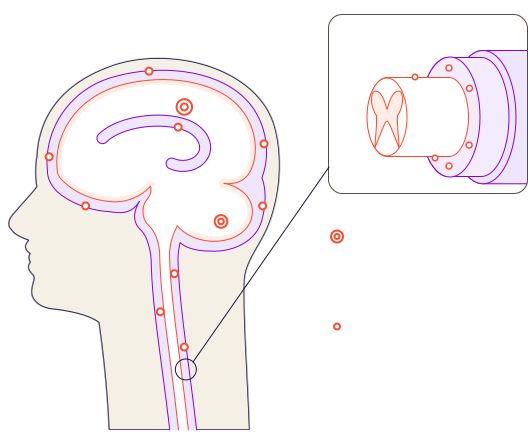
Magnified: The Spinal Cord
CNS tissue
In the tissue
Some form tumors in the tissue of the brain or spinal cord itself.
CSF & leptomeninges
In the fluid
Others spread as cells through the fluid that surrounds the brain and spine.
Radiotherapeutics: a more targeted treatment.
On the treatment side, Cerenome’s focus is targeted radiotherapeutics, an emerging class of cancer treatment. Radiation has long been limited by where it can safely go in the brain, since healthy tissue can only tolerate so much.
Radiotherapeutics are designed to deliver radiation more directly to sites of disease, with the goal of concentrating treatment where it is needed while limiting radiation exposure to surrounding healthy tissue.
The cancers Cerenome focuses on:

Recurrent glioblastoma.
The most common and aggressive brain tumor in adults, and one that usually returns even after the best care available today.

Pediatric brain cancer.
The second most common cancer in children, where the options that exist are often limited, invasive, or hard on a still-developing body.

Leptomeningeal metastases.
A rare cancer that happens when cancer spreads into the fluid surrounding the brain and spinal cord.

The reason the work matters.
Understanding these cancers is one thing. Hearing from the people living with them is another. Their experiences are why Cerenome does what it does.
Where to turn for support.
Beyond information, there’s support. National advocacy organizations can connect you with others who understand and help you find your footing. And if you’re wondering whether a clinical trial might be an option, that’s a conversation for you and your care team.
Questions for your care team
- What type of CNS cancer is this, and what does that mean for me?
- What are my treatment options, and what is the goal of each, controlling the cancer, managing symptoms, or something else?
- Could a clinical trial be an option for me, now or later?
- What can I expect day to day during treatment, and how might it affect how I feel?
- Who is on my care team, and who should I contact when questions come up between visits?
Where to find support
- American Brain Tumor Association
- American Cancer Society
- Brain Tumor Network
- Dictionary of Cancer Terms
- End Brain Cancer Initiative
- Head for the Cure
- Leptomeningeal Cancer Foundation
- LUNGevity
- MedlinePlus (NIH)
- METAvivor
- National Brain Tumor Society
- National Cancer Institute
- National Comprehensive Cancer Network
- Support Groups Listing
- The Brain Tumour Charity
- VirtualTrials.org